
 What are the Shoebill Birds that we see in Uganda?
The Shoebill (Balaeniceps rex), commonly known as Bulwe in Luganda, lives in undisturbed wetlands of Africa; specifically, it is endemic to countries such as Uganda, Sudan, Ethiopia, and Rwanda. Furthermore, researchers once recorded sightings of this large stork in Burundi. Consequently, these specific habitats provide the isolation the bird needs to thrive.
Characteristics of Shoebills
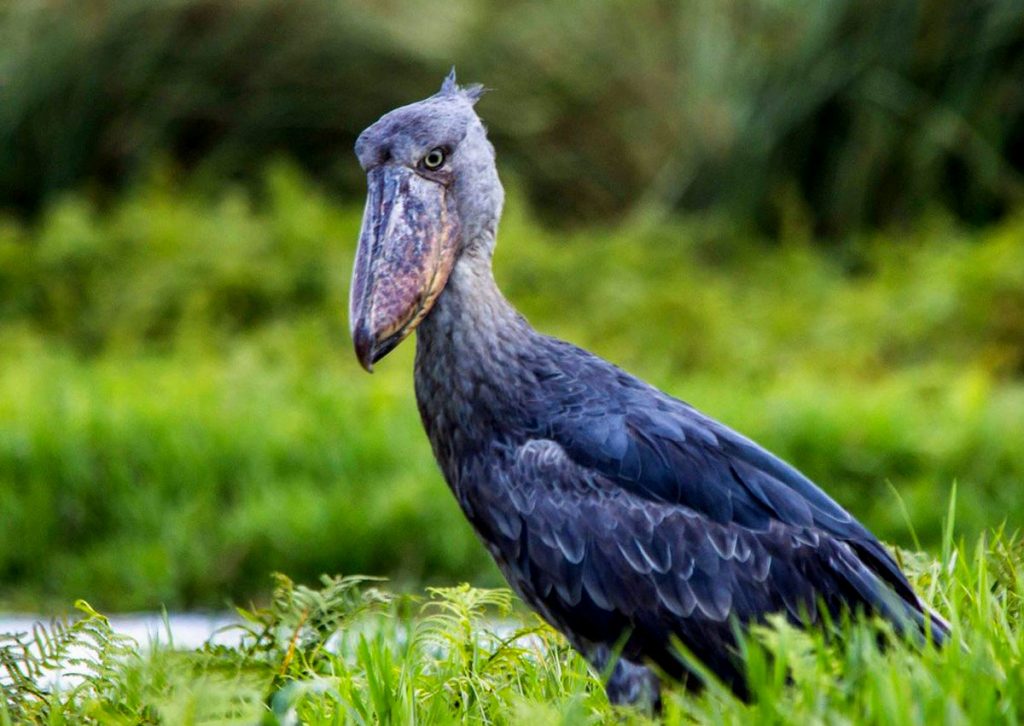
It’s about 128cm, weighing about 5-7 kg. Both sexes are grey, with pale grey eyes and long grey wading legs that enable them to stand in wetlands to catch prey; immatures are brown.
The Shoebill has a small raised crest and a big shoe-like hooked bill which helps it hook away its pray at the sides of its bill has a scissor-like which helps the bird squeeze and kill the prey, It holds Its wings in flight and can flap 150 times per minute It’s the first African bird of sought( a bird one should see before he dies) because it didn’t go through revolution and its believed to be a nasal still,
Shoebills live as solitary birds that feed primarily on lungfish, frogs, Nile monitors, and baby crocodiles. Specifically, they can stand still for up to five hours; consequently, they use their sharp vision to strike prey with a 60% success rate.
These birds remain monogamous and build flat ground nests out of dry papyrus on floating vegetation. Furthermore, both sexes build the nest, although the female lays 1 to 3 eggs and incubates them for 30 days. Finally, the female takes primary responsibility for looking after the chicks once they hatch.
Female Shoebill
The female Shoebill stores food in her gullet and subsequently feeds it directly to her young. The chicks begin flying at 112 days; however, they remain highly sensitive to human presence and may abandon the nest if disturbed. Furthermore, the birds reach maturity in about two to three years. Interspecific competition for food often occurs among the young; consequently, the first-hatched chick usually pushes its siblings out of the nest to ensure its own survival.
Conservationists classify this bird as vulnerable; consequently, they estimate its total population at only 5,000 to 8,000 individuals. In Uganda, birdwatchers commonly spot it in Mabamba, the Semliki Wildlife Reserve, Katonga, and Murchison Falls; travellers have recently sighted it in the Kiryandongo area as well.
Lifespan is about 25-30 years.
Fishermen believe this bird is a bad omen. When they find this bird on their way to fishing, they never catch fish, so they kill it. However, through sensitisation of these people, there is a reduction in bird killings.